


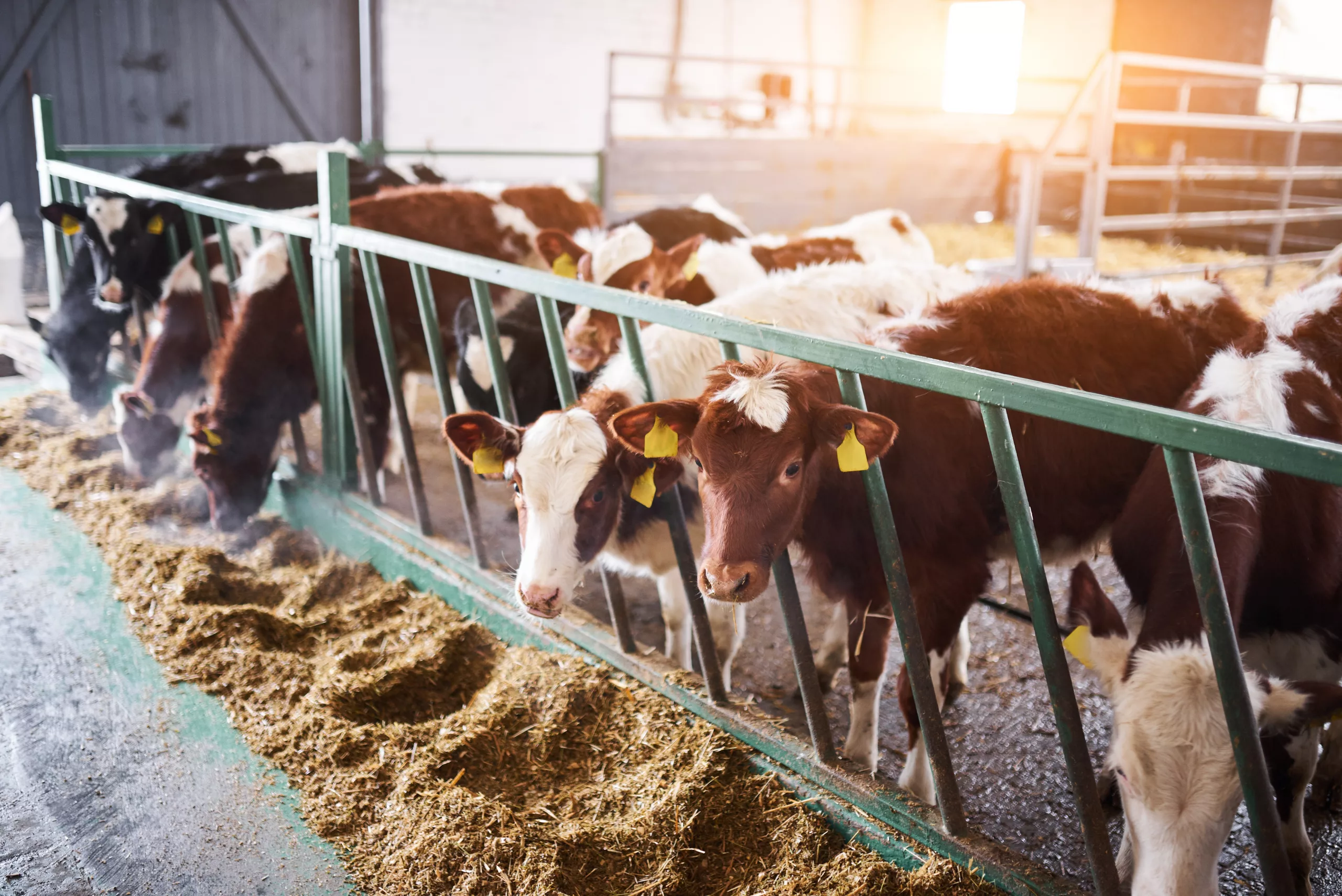
Ventilation System
ClimaBarn can be adapted for almost any livestock or agricultural application. Our systems are already used for cattle, pigs, poultry, sheep, goats, rabbits, and horses, among others.
Because every barn and herd is different, we design each system individually. That means we can adjust airflow, speed, and distribution to match the specific needs of your animals and facility. And it’s not only for livestock. Fabric ducting can also be configured for special agricultural or industrial needs. For example, reducing humidity in storage halls or improving air circulation in sensitive feed and crop storage. If your application isn’t listed, just ask us. Our engineering team will find a way to adapt the system to your animals or facility.
Yes. Even in winter, cows need fresh air to remove moisture and ammonia that build up in closed barns. Well-designed systems run fans at low speed and diffuse the supply air in a way that it mixes with the room air before reaching the animals, keeping the barn dry and healthy without chilling the cows.
Yes, by default ClimaBarn systems have a built-in automation system to control the airflow based on temperature in the barn. It ensures the right amount of air all-year-round by providing less air in cold season and gradually more air as weather gets warmer. System capacity and automation is designed to cope with the warm temperatures, however there is always a power reserve left that the system owner can activate to ventilate full power during extremely hot days.
ClimaBarn systems come in 9 standard colors that the customer can freely choose from: white, light grey, dark grey, blue, green, red, orange, tan and black.
Yes. It runs continuously, day and night, all year. The airflow is automatically adjusted to the temperature in the barn. On extremely hot days, the airflow can be manually increased to full-power for extra cooling.
No. ClimaBarn systems are made of polyester fabric, which naturally have noise-absorbing properties. This means the fan noise over the length of the duct is absorbed contrary to other hard material systems which allow the noise to transmit. The air dispersing through the fabric surface and the ventilation outlets (orifices or nozzles) makes a steady background hum to which farmers often report that cows quickly adapt and remain undisturbed.
The main difference is that fabric duct systems deliver fresh outside air directly to the animals at high speed, ensuring effective cooling. The air is distributed along the entire length of the duct, eliminating “dead zones” or stagnant spots, so every cow receives a steady supply of fresh outdoor air, no matter where it is in the barn. Fabric ducts work exclusively with outdoor air, functioning much like personalized ventilation for each animal.
In contrast, other solutions such as ceiling fans or overhead axial fans mainly recirculate the barn’s polluted indoor air. These systems follow a “one-size-fits-all” centralized ventilation approach, which often makes it difficult to achieve uniform airflow and guarantee that every cow gets the fresh air and cooling it needs.
Many farmers notice calmer, less stressed animals after installing a fabric duct system. Cows no longer crowd at one end of the barn in search of fresh air or flick their tongues to cool themselves—because they already have consistent, comfortable airflow throughout the barn.
Delivery & Installation
Yes, installation by FabricAir installation team is included in the standard offering.
Once the scope of your project is fully defined, we move quickly into production. While many suppliers typically require around four weeks or more, our in-house manufacturing setup allows delivery to start from as little as two weeks. This shorter lead time means you can have your ventilation system up and running faster, ensuring your animals benefit from improved barn climate without unnecessary delays. We always strive to process orders as efficiently as possible, while maintaining the highest standards of quality.
FabricAir Installation team typically finish the installation in 1-2 days depending on the project size.
Maintenance
ClimaBarn systems are very low-maintenance. The main tasks are cleaning the fans and occasionally washing the ducts. Fans should be checked every few months for dust, which can easily be brushed off with a cloth. The ducts themselves typically only need cleaning for visual purposes, normally once a year – either by gently rinsing them in place with low-pressure water or taking them down for a wash. The textile is durable and designed to withstand regular cleaning without damage.
Aside from that, only basic checks are needed: look for sagging, inspect suspension cables, and repair any small fabric tears if they appear (due to external abuse, almost never during normal operation). Compared with metal systems that often require rust prevention and more intensive upkeep, ClimaBarn offers a simple, farmer-friendly maintenance routine.
No – condensation does not form on ClimaBarn fabric ducts. The ducts are made from an air-permeable textile that allows a constant flow of fresh air through the material. Because the surface never traps humidity, there’s no chance for condensation to build up and drip.
Condensation issues only occur with airtight materials (like metal, coated fabrics or plastic film) where moisture collects on the surface and leads to dripping and algae growth. With ClimaBarn’s permeable textile, the ducts stay dry, clean, and reliable, ensuring a healthier barn environment without “sweating.”
Warranty & Life Span of the System
FabricAir, the market leader in fabric air dispersion systems with more than 50 years of experience, has installed fabric duct systems across a wide range of applications worldwide, including those operating in harsh environments. Our proven track record demonstrates that our systems are both durable and long-lasting. A benchmark example is a meat processing facility in Denmark, where our systems have been in operation for 48 years. They are regularly washed and continue to function flawlessly to this day.
Price
Each ClimaBarn system is custom designed and manufactured per your specific situation. There is a minimum input needed to determine the system size and capacity which directly impacts the cost. Please refer to ClimaBarn Price Estimator to provide few inputs and get an estimated price instantly. Note that it is an estimate, please submit your calculation report afterwards and we will contact you for consultation and exact price offer shortly after.
By the way, in most cases system pays for itself after one heat-stress season. Check the Proce Estimator for more details.
Each ClimaBarn system is custom designed and manufactured per your specific situation. For this reason, there is no standard cost per m². However, in almost all cases ClimaBarn system pays for itself within one heat-stress season. Please visit our Price Estimator to calculate an estimated price and Return on Investment (ROI) instantly.
ClimaBarn systems help cows to feel comfortable and avoid heat-stress which results in higher milk yield, improved health and less veterinary costs. When these benefits are monetized and compared to ClimaBarn investment costs, typically the ROI is withing one year depending on your specific inputs such as herd size, milk price, electricity price, etc. Please visit our Price Estimator to model your specific case and calculate the estimated ROI.
Livestock Health
Cows require a lower but steady rate of air exchange in winter and a much higher rate in summer. A common guideline is about 4 air changes per hour in winter (to remove moisture and gases without chilling the barn) and up to 60 air changes per hour in summer for cooling. In practice, this means the barn air should be completely refreshed about every 15 minutes in cold weather, and as often as once per minute during hot weather. This high summer ventilation rate helps carry away heat and humidity, preventing heat stress. The exact needs vary with barn size, animal density, and outside conditions, but the goal is to keep air fresh in all seasons.
Cows begin to experience heat stress at relatively mild temperatures, often long before humans feel uncomfortable. When this happens, they eat less, ruminate less, and milk yields decline. Proper barn ventilation helps by removing hot, humid air and replacing it with cooler, fresher air. Just as importantly, it creates steady air movement over the cows, producing a wind-chill effect that helps them shed excess body heat.
On-farm practice show that air speeds of about 2-2,5 m/s at cow level are needed on hot days to provide effective cooling. ClimaBarn systems are designed to deliver this consistent, targeted airflow, ensuring cows stay within their comfort zone even during the hottest months.

